
No worse time to start a brand
But more designers than ever willing to take the leap
There is a worrying upward trend in the number of designers planning to start a brand. The reasons for them wanting to do this vary: there aren’t enough industry jobs for the number of fashion grads leaving school, for example; or their values (sustainability, work/life balance, climate change, etc) don’t align with those of employers; but most often, motivation to go down an entrepreneurial route is externally driven. Rather than a deep, personal consideration, we see industry incentives becoming the main decision maker: the graduate landed in an uncertain post-graduation holding pattern where their work is being validated by media and some stores – making them believe there’s ‘traction’ and that they should start a brand, even if they never actually consider doing that.
The shift is significant. Why, in these economically challenging times, are so many young graduates convinced that launching a business is a good idea?
In the past couple of years, there have been multiple closures of businesses who had reached success on an international scale, such as Christopher Kane, MATCHES, almost Roksanda, just yesterday – The Vampire’s Wife, and, less publicly, there are multiple independent brands out of business that are not admitting it yet to the public (or to themselves) and keep up with appearances to avoid creditors knocking on their doors.
Trino Verkade, the CEO of Sarabande Foundation, told us years ago:
“I am worried about the next generation of designers. They step into this industry with so many expectations. The role of the fashion designer has been glamorised, and young graduates all jump to the occasion to launch their own brand. When I started working in fashion, only a handful of designers came out and set up their own labels. Now, new labels are born every season. There just isn’t enough growth in the industry, globally, for all these young brands. We can’t all be amazing designers, even if media, culture and education makes us think otherwise.”
One of the vital issues that we’ve witnessed is that the industry creates an illusion of demand which designers get pulled into without being aware of the mirage. Media needs content to fill their (digital) pages, retailers need fresh talent to keep feeding their 2% of ultra-wealthy customers with constant newsness and differentiate from each other (unless you sprinkle in youthful creativity, e-com homepages will just all look homogeneous stealth wealth, and fashion education became a lucrative business, so why not keep churning out more fashion grads?
There’s a gaping and nefarious disconnect between what the industry demands and what consumers actually buy.
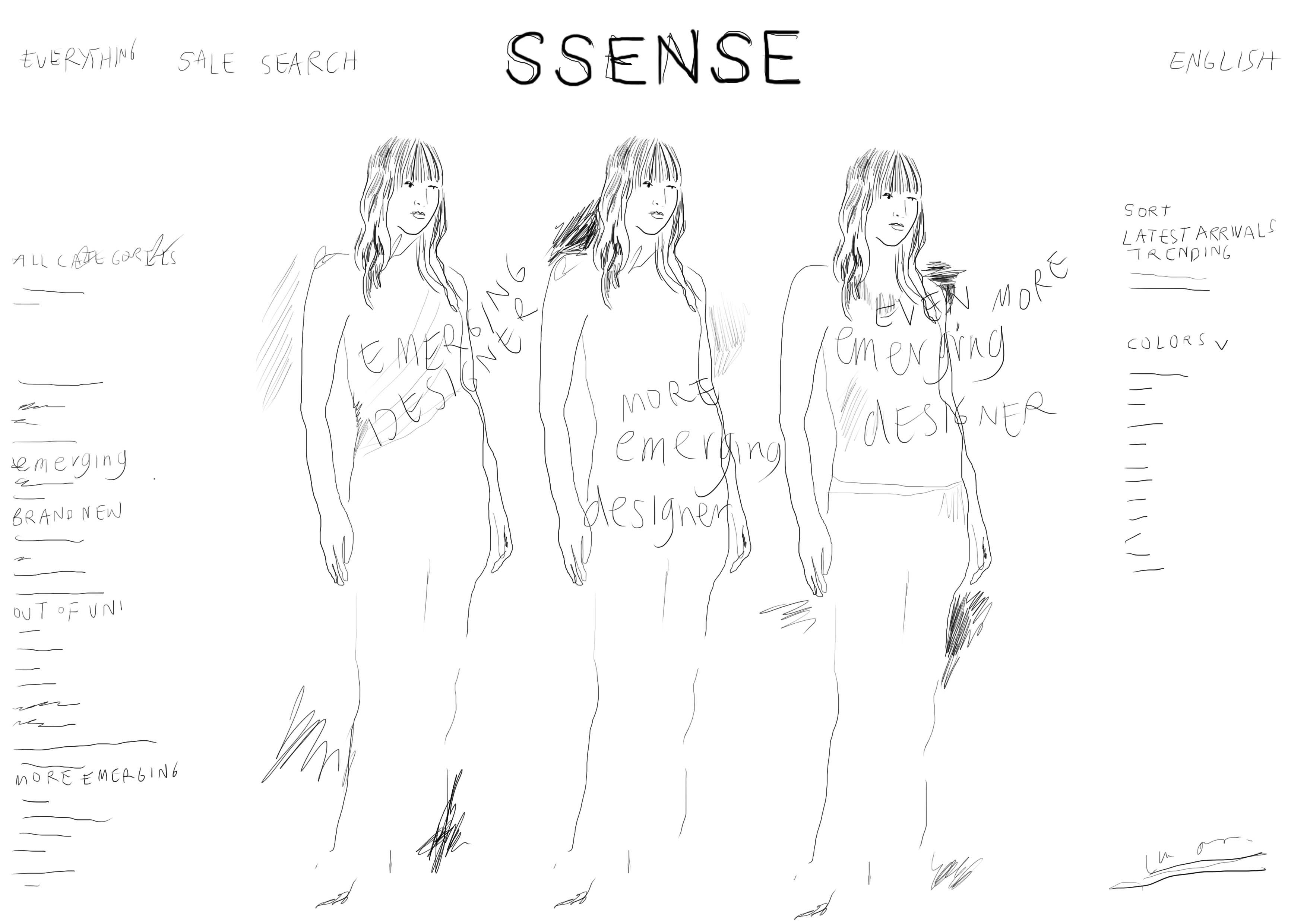
Too often, graduates decide to go independent after a retailer like SSENSE reaches out with interest in their collection. In the majority of these cases, however, that interest doesn’t directly translate to an order, or at least not one of a significant amount. Of course, a company like SSENSE is simply making sure that they get their hands on talent before their competitors do. But designers should understand that the retailer has most likely reached out to dozens of other graduates with the same request, just to make sure they’re the first.
In this case, the retailer creates an illusion of demand. But the reality of the wholesale business is infinitely more complex.
The fashion industry is built for growth. What does that mean for the independent designer? It means they are expected to scale up the second they step into wholesale. Working with retailers means working with factories. This means minimum order quantities, as factories don’t accept small, one-off orders. You need high volumes. This is when costs accelerate. Just think of material sourcing, transport, and import costs. Realistically, you need to sell a couple hundred grand in your first few seasons, moving up to a million, to cover those costs.
It’s an economic model that doesn’t exactly favour small-scale independence.
But while production and wholesale suffocate the young on one side, media and PR blow them out of proportion on the other. Publicly, our industry demands a perception of success. Fashion media comfortably promote first-season newcomers to their mass followings as ‘groundbreaking’ and ‘subversive’, without considering whether there’s an audience ready to support them financially. Stylists dress their celebrity clients in graduate collections and support schemes host spectacular shows presenting their work to international audiences. The designer is transformed into a promise that cannot be fulfilled.
Another illusion: this time, it’s one of large-scale cultural impact and significant reach. It’s not because your dress has been worn by an international pop star that you can level the success of that pop star. Because the fashion industry is highly saturated. It takes immense investment to build a customer base and brand recognition. Industry approval doesn’t translate to sales.
Time to reflect: zoomed-out perspectives
It’s time for this industry to question itself. Where does my responsibility lie? For graduates, this means stepping out of the cycle of expectation for a minute; zooming out for a dose of both esoteric and practical perspective. Ask yourself: what does success actually look like for me, in the short and long-term? In the closed-off and competitive environment of education, our expectations can become dogmatic, and we believe there is only one way to do it right.
Does success mean being a Design Director at a leading fashion house with a 250k+ salary but compromising on all other aspects of personal life like physical and mental health, being able to build a family, or pursuing other interests? Does it mean joining NEWGEN and then winning the BFC/Vogue Designer Fashion Fund while producing a fashion show, even if you don’t have the budget to pay your collaborators?
Can we really sit with ourselves for a moment and think hard about why we do what we do, without the noise of culture or societal (and peer) pressures? Can we think long and hard about the structures and myths of the industry that we’ve internalised? Do we have the courage to pivot if it feels right?
The illusion that spells ‘success is easy’
It’s not a bad thing to take risks. It’s not stupid to try something or to want to create for yourself and resist the conglomerate-dominated career paths. But there are more ways than one to do that.
In an interview with SSAW last year, Fabio Piras reflected on his 10-year tenure as MA Fashion course director at Central Saint Martins. Answering the question: “Has there been a big change in terms of who starts their own brand and who decides to work in-house?”, he said:
“I think more people need to start their own brand. We are in a system where if you want to make an income and be fulfilled in what you do, enterprise is a great place to be. It’s super hard, but it brings you not just attention, but work, income. This idea that I keep hearing, that you need to have experience, well, what experience? You have education of more than 6 years. But also my claim would be… you need to be a loose cannon. You’re young. In anything that is entrepreneurial and artistic, you never have the guarantee that you’re going to make it.”
Fair point: in today’s climate of possibility, why not give it a shot when you’re still young. Certainly there’s room for nuance here. But this stance begs the question: if we push emerging talent to start their own brand, what responsibility do we have in our relative positions of power as media, educators and retailers? And if educators push designers to start brands, why not equip them with the necessary thinking and skills to create sustainable businesses?
The phenomenon of mega/microculture across the arts
If there’s a shift in how designers consider setting up their business – in tune with the reality of the times – perhaps they can last. Simultaneously, and perhaps distressingly, they enter an industry that is experiencing a phenomenon applicable to practically all art fields: that of mega/microculture. Here’s a great passage from Network Notes to illustrate the point – they write specifically about music, but this certainly feels applicable to fashion (and art, cinema, etc), too:
“Previously, we had something of a monoculture society; more limited gatekeepers were able to feed people select recommendations, and as a population (irrespective of the country we are in) we moved accordingly. It’s how you had emergent genres like grunge arguably take over the world: the key gatekeepers decreed it to be the Next Big Thing, and we all dived in accordingly. Well, a sufficient number did anyway.
With a monoculture you also had a more consistent path of growth for artists; the small, middle and big leagues, if you will. Artists could move from playing small clubs to playing bigger venues, and eventually they’d accede to stadiums if fortunes really went their way. Ditto music press (from zines to the likes of Pitchfork) and radio (from local/college stations to the big influencers).
Even as the likes of MySpace, then Facebook, Twitter, Instagram et al grew, we still had gatekeeper media nodes that were able to influence and steer culture.
In 2024 it feels like things have been different for some time now, and the change as I see it is a movement from the monoculture of old to what I’m terming “mega/microculture”. Put simply, the big artists are bigger than ever, mega-sized even (e.g. Taylor Swift), but then there’s an increasingly stark gap until you get right down to the smallest microcultures that are tiny, highly fragmented and increasingly unable to really make a dent.”
What we see with Universal Music and the indie artist is what we see with LVMH and the upstart brand. So what does that ultimately mean for somebody who emerges out of the art school trenches aged 26? And what does it mean when on a list of ‘notable alumni’ by a famous school, the only fashion graduates mentioned are those who started their own brands?
There’s a lot of question-asking to be done – not just for the designer, but to everybody who’s involved in the world of emerging brands. There is no universal answer on whether or not to start a brand, or what success means: all of this is in the eye of the beholder. What we simply noticed is a peculiar moment in the industry: there seems to be no worse time to start a brand, but more designers than ever are willing to take the leap.
What success means for 4 of London’s independent brands
KNWLS
To be able to do what we want with as little friction as possible – in life, business and creatively. We just love the power fashion has to bring people together, to connect with all forms of art, making things and building worlds. The goal is to be able to do it without financial restrictions. I don’t think we need to be Gucci to do that; we just want it to be big enough so that freedom can reflect in our personal lives. I would say the goal is more Rick Owens-size than Gucci – past that point it’s just superfluous.
SETCHU
As a brand, success means being able to excite people around your work; it doesn’t have to be mainstream. For me, fashion is all about human communication – a successful company can show their community how the brand is growing and make them feel happy to be involved. Numbers are important when you have restrictions, but personally success means having a good balance in life and being able to do what makes you feel fulfilled. I have bigger ambitions that don’t necessarily require more ‘followers’, although I accept that I live in a capitalist world where growth is important. I’d like to maintain my own oasis, and by engaging with the right people, I make sure it stays unpolluted.
JOHANNA PARV
I don’t feel I want to be the next conglomerate-size brand. And I don’t think I feel much of the pressure of ‘making it’. For me ‘making it’ is when I have managed to create a sustainable business that allows me to do what I love. I consider a brand a success if you are making exceptional products that people can enjoy.
YAKU
As a business, being able to manage and exist; to learn a lot of aspects of running a business and staying alive by doing that is a success, because it’s really tricky. Related to that, being able to reward our staff and interns how we’d like to – is something which feels like a success. I think that success to me is constant improvement on all levels; it doesn’t really have checkpoints. Success on a design level comes from the freedom to play, which is informed by the money that’s available. And also, on a more personal level, it’s about still being really excited about the work that we create, and to be intrigued by what the objects could become.
Words by Jorinde Croese


Fantastic write-up, once again.